UX, Art Direction & Animation: Sprint Mobile Network Landing Page
The Ask
Create a landing page promoting 4G LTE Advanced while giving customers a preview of Sprint’s 5G future and find a natural way to connect all of that to device sales.
The Approach
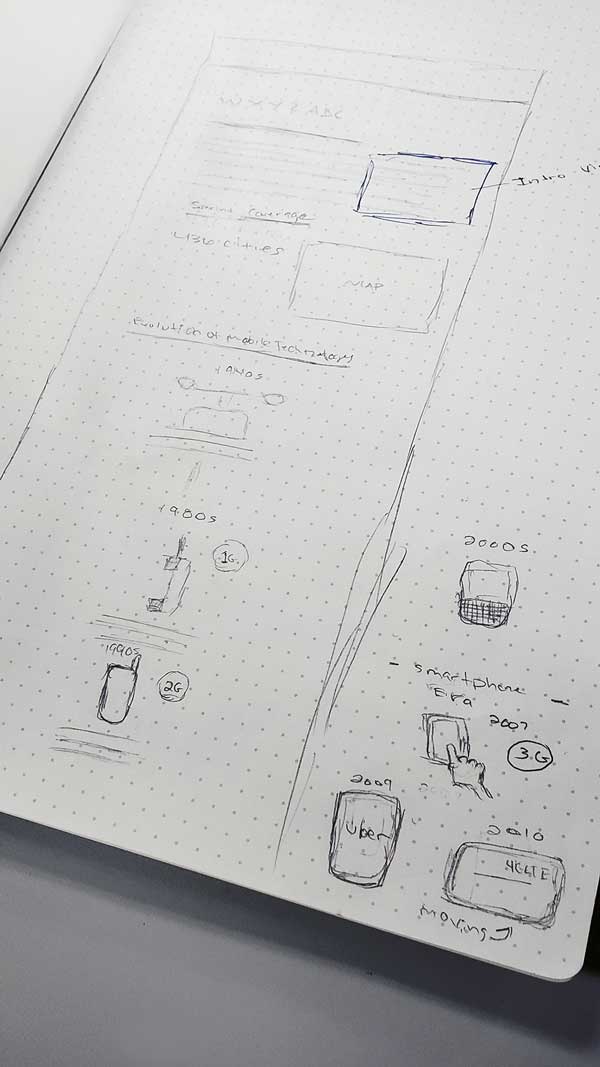
I initially envisioned a pretty ambitious experience: lead with Sprint’s 4G LTE Advanced commercial and a brief introduction to the technology, then let customers explore its availability across 436 cities through an interactive coverage map. From there, I wanted to tell the 70 year story of how mobile technology had evolved and where it was headed next.
It was a strong concept. The problem was that our digital ecosystem wasn’t ready for it.
Designing Around the Gaps
Sprint didn’t have an interactive coverage tool. In fact, we didn’t even have the basic ZIP code service checker that other carriers already offered.
Rather than treating that as a dead end, I saw it as a larger UX problem worth solving. I started pushing for a service-availability checker on the homepage, a feature that eventually launched two years later.
For this project, though, I had to work within the constraints we had.
Marketing could provide a static coverage map and a PDF listing the 436 cities with 4G LTE Advanced.
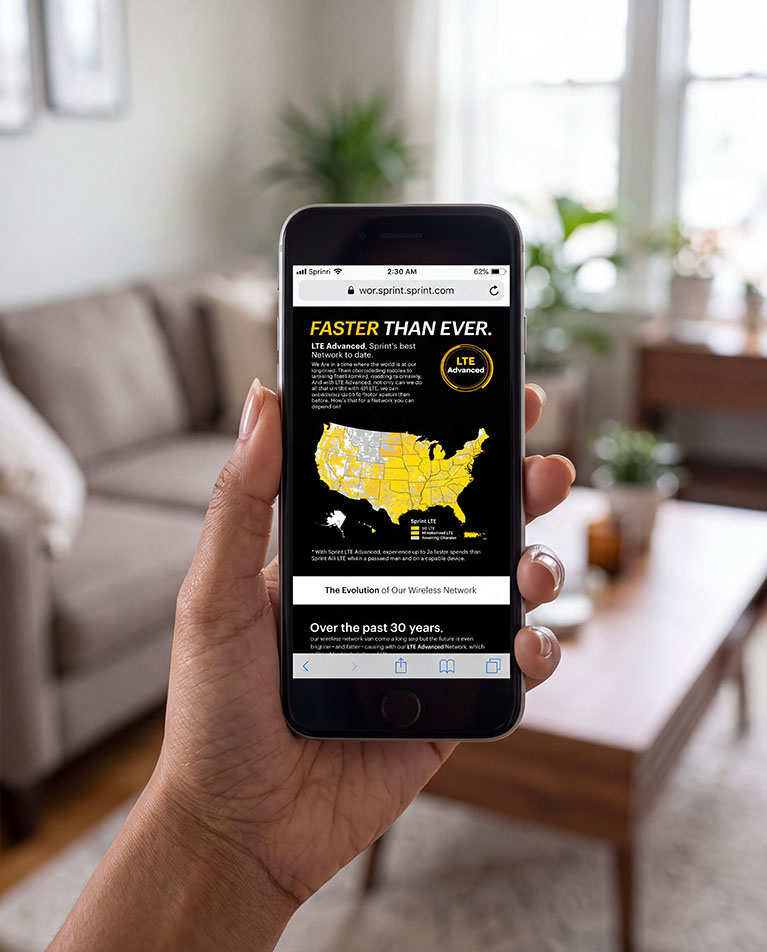
It wasn’t the experience I wanted, but I ensured the PDF open in a new browser tab so users could reference the information without completely leaving the landing page.
Then I looked for an opportunity to turn the rest of the experience into something more engaging.
Turning Technology Into a Story
I partnered with our Head of UX and copywriting lead to rethink how we explained the technology. Instead of making the page a collection of technical specifications, we condensed roughly 70 years of mobile innovation into a “30 Years of Sprint x 4G LTE Advanced” story.
I designed an animation that compared the evolution of mobile speeds, from 1G through 5G, using tiny cars traveling along roads.
Network Animation
The metaphor was intentionally simple. Faster technology meant faster cars. Customers didn’t need to understand the technical differences between network generations to immediately see the difference.
Making the Components Work
Once we had the story, I turned my attention to devices.
Sprint’s developers hadn’t yet built a reusable carousel component, so I worked directly with the authoring team to build a device wall in Adobe Experience Manager.
It wasn’t an ideal solution, but it got the experience into customers’ hands. More importantly, it exposed another recurring problem: we were repeatedly designing around missing components instead of having a flexible system that supported the experiences we wanted to create.
I flagged this as another area to address and eventually pushed for better component capabilities.
Turning Content Into an Experience
The final piece was Sprint’s 5G video content.
The in-house team had produced 8 videos about the future of 5G at Sprint, and I didn’t want that content buried behind a single hero video. Instead, I turned it into a dedicated learning section where customers could explore the different aspects of Sprint’s 5G vision.
Once again, there was a platform limitation: Sprint’s Adobe Experience Manager didn’t have a video gallery component.
So I worked with the authoring team to piece one together.
What I Took From It
This project started as a landing page exercise, but it became a lesson in designing within, and pushing against, the limitations of a digital ecosystem.
I had to balance the experience I wanted to create with the tools, components, content, and capabilities that actually existed. When something was missing, I looked for a workable solution in the short term while identifying what needed to change in the larger system.
The result wasn’t just a page promoting 4G LTE Advanced and 5G. It helped surface several foundational UX opportunities—from service availability tools to reusable components—that could make future experiences better, faster, and more scalable.
Network Page Wireframe Sketch
Final Design in Motion
- Head of UX: C. Hamblin
- Copywriter/Researcher: E. Choi
- Objective: Announce 4G LTE Advanced availability (for some phones)
- Concept: The evolution of mobile technology leading up to 4G LTE Advanced and forthcoming 5G
- File Versions: 15 🙃